
BLOG
Finds and Interests
Some of you may know that I collect vintage photographs and negatives. I built a website called History in Photographs to highlight and share the collection. These are more than just simple snapshots; they give us a glimpse into history and leave us with questions.
I’ve selected a few of the most intriguing and am excited to share what some experts have told us about the hidden narratives and stories behind each photo.
For these photos, we worked with Meghan Boehmer, a historical interpreter, reenactor, and writer who has traveled thousands of miles to learn about historical locations, records, and figures. She has agreed to share her expertise in period clothing with me, hoping to enhance our understanding of the subjects in the photos. Please take a look at what she was able to tell us about this photo.
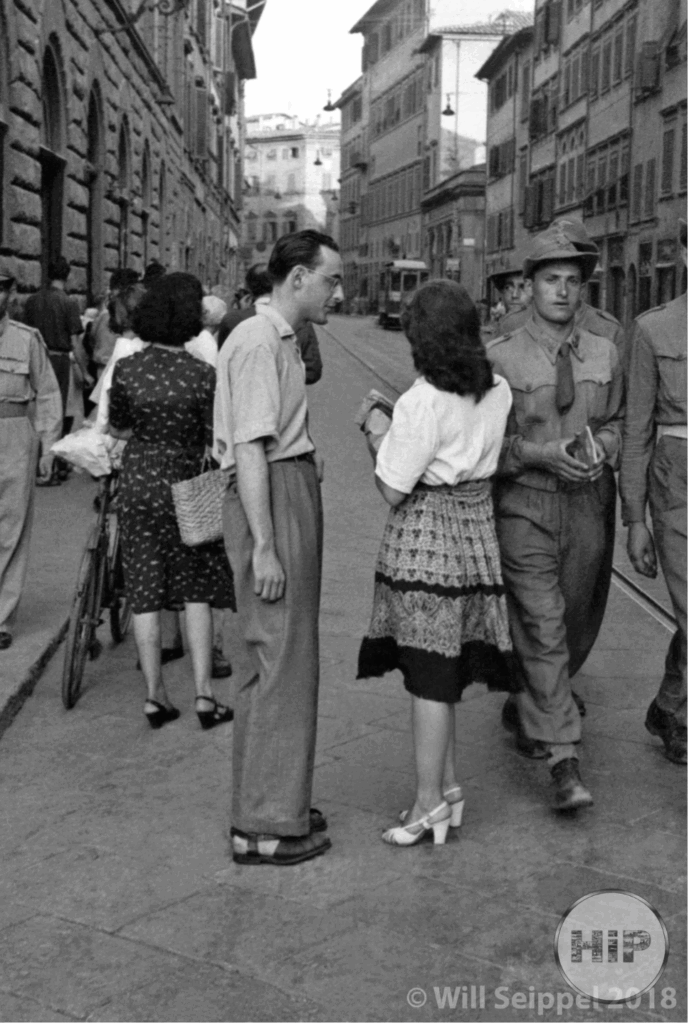
Wars are often a time of rationing, and beyond rationing food, textiles are usually rationed, as those factories can be better utilized to supply silk for parachutes or to produce the vast quantities of uniforms required to outfit an army. The effect of rationing is most evident in women’s clothing, as illustrated in the image below. The first notable sign of rationing is the length of the skirt hems. While hem lengths had changed gradually, starting in the late teens (also influenced by a world war), the basis for comparison remained skirts that reached the ankles or the floor. In the aftermath of WWI, skirts continued to shorten, although they remained below the knee, often at a tea length (somewhere between the knee and ankle). In the 1930s, the lines of garments slimmed, and skirt length remained unchanged, perhaps due to the Great Depression and the high cost of materials.
By the time World War II reached Italy, hemlines shortened again due to rationing, as shorter skirts required fewer yards of fabric to produce them. You can see here that the women’s skirts barely cover their knees. But there is more evidence of rationing. In the 1930s and 1940s, women’s silk stockings had a seam up the back. Due to silk rationing, silk stockings were a luxury that many women could not afford. In fact, during the war, women could purchase pencils similar to an eyeliner that they could use to draw a stocking seam up the back of their calves to hide the absence of stockings.
The soldier wears another notable fashion in this image on the right. This hat is known as a slouch hat and is specifically a part of the Australian army uniform. The style has existed in some iteration since the 18th century. It would have been called a cocked hat. Soldiers would cock the right side of a flat-brimmed hat so their musket wouldn’t knock their hat off their head during maneuvers.